


During the many periods of severe depression I’ve experienced over the course of my adult life, fiction, media, stories have always played a massive role in my recovery. There’s a pipeline that I seem to get drawn through, a particular way that stories have of leading me out of the darkness.
At first, immersing myself in a fictional world simply offers distraction from depressive thoughts. After my most recent episode of depression, I’ve realized that this kind of distraction is actually a very healthy, helpful coping mechanism when depression is so severe that it becomes fully disabling.
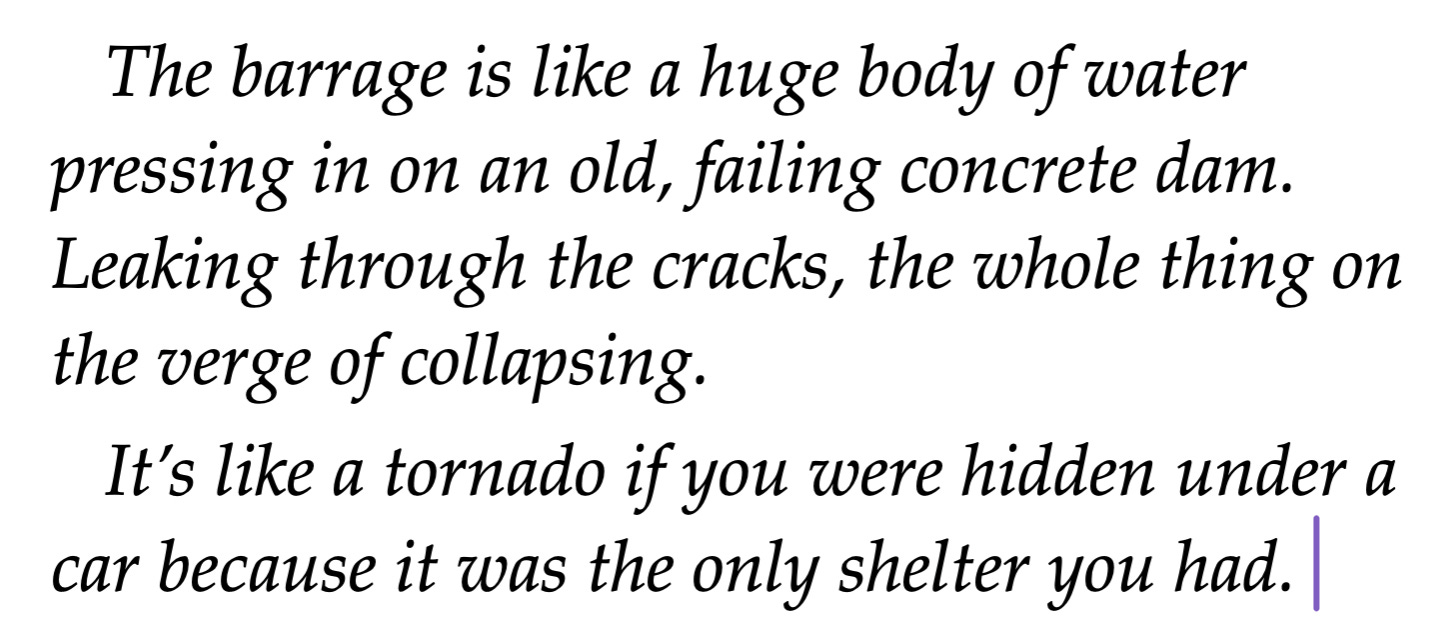
My depression is now inextricably linked with PTSD. I struggle, even outside of depression, with an intense degree of intrusive thoughts, unwanted rumination, and flashbacks. In severe depression, it becomes truly unbearable—every minute of every hour of every day in which I don’t have something to occupy my brain is filled with distressing imagery, memories, words. This is not an exaggeration, I don’t know how to fully articulate how bad it is. My screen time hours during severe depression were horrifying, which is something I still feel a high degree of shame about. But the reality is, my stupid little phone felt like the only buffer I had between myself and the constant barrage of intrusive thoughts.
As you might imagine, while things like social media doomscrolling fulfill a certain function in slightly holding the PTSD symptoms at bay, they don’t do a lot to move a person out of depression. But when I’m struggling with severe anhedonia and avolition, it’s extremely difficult to focus on anything at all for any meaningful period of time. Fiction is often the first thing I have access to that will allow me this focus while still offering a way to manage the intrusive thoughts, and is often more effective at doing that than something like doomscrolling.
I’ve realized that any break from the endless, circular rumination and hopelessness of severe depression is a good thing. It might feel like nothing in the moment, but for me, it was the first step in gently rewiring my brain simply by giving my mind a chance to breathe. This reprieve is crucial.
After the initial period of simple distraction, something else begins to happen—I fall in love with characters. This is where the real magic begins. I feel kinship with them—I begin to see myself in them, in their struggles. I watch them overcome obstacles. I’m there with them as they find love, healing, connection, joy, happy endings. Happy endings are important to me.
In this way, I begin to imagine that my life could be different. If they can do it after what they’ve been through, maybe I could too? It is only ever in imagining that my life could be different that I have managed to… make my life different. It’s like a personal form of prefiguration. Particularly when I’ve been very isolated, fiction has been invaluable in this way.
Romance has been the frame that really brings everything together. The concept of finding yourself in a character, seeing that character through the eyes of their love interest, watching them come to understand that they are lovable. Not in spite of their quirks and issues, but because of them. The character of Shane from Heated Rivalry and his romance with Ilya is the most recent example of this for me. Shane is canonically autistic in both the book and the show, and seeing the ways that Ilya actually adores his autistic traits has been healing for me as I process being a newly-diagnosed autistic at the age of 33.
But in all of this, there has always been one major thing missing: my story. I’ve never been able to find a character who truly feels like me. I’ve searched extensively. What I’ve been craving most are stories with bipolar or schizo-spectrum characters that explore the full complexity of our experiences, but especially romances. The one book I’ve found that fits the bill is Glitterland by Alexis Hall, a beautiful queer story featuring a depressed bipolar protagonist and his unexpected love interest.
But, of course, as a sapphic person, I’ve been craving a Glitterland of my own. Because I haven’t found one after years of searching, I decided to write it myself.
There are two things that pushed me to start writing: a beautiful work of Heated Rivalry fanfiction about writing itself, and a post on Instagram from Goldie Jones about the idea of Heated Rivalry as a corrective emotional experience.
I’ve been enthralled by the idea of corrective experiences lately.
Neuroscientists have researched what they call memory reconsolidation. It’s where you revise an emotion tied to an old experience with a new emotion. As you update this memory, you actually create a neurological change in your brain.
Therapists call this process a corrective emotional experience.
During therapy, as you explore the past, the therapist responds in a kind and loving way, which corrects the emotional experience you had in the past.
Though this article focuses on corrective experiences as they happen in traditional talk therapy, there are many other ways to access these experiences. There are therapeutic methods like psychodrama therapy that allow participants to roleplay past traumatic events in a group setting, which is powerful on its own because it allows them to be witnessed. But even more powerfully, psychodrama often involves literally re-writing the endings of traumatic events and acting them out. Here’s how I wish this could have gone. Someone stood up for me. I left. I fought back. My abuser died. You might think this could be depressing, because after all—things did not happen that way. But the act of roleplaying the alternate version of events with others seems to have the ability to convince your brain and body that yes, this is resolved now.
Beyond intentional therapeutic methods, many corrective experiences come simply through human relationships. You have a strained relationship with your mother and you find a supportive female mentor. You were in an abusive relationship and then find a loving partner. You were isolated and then you find a group where you fit. These experiences change your mind, your expectations, your view of yourself.
So far, writing fiction has been the most impactful and healing corrective experience of my life.
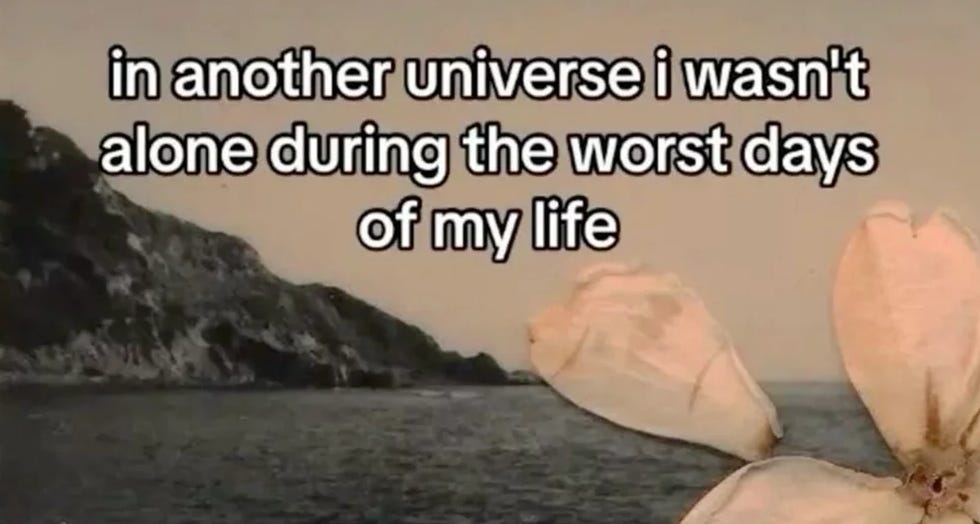
My novel, which has the working title Quantum States, has a simple premise—what if I had someone who was present for me, cared for me, saw me in my fullness as a person during the darkest moments of my life?
The story begins as autofiction—a fictionalized recounting of my real experiences. Then, there’s a divergence of events as my main character, Cory, convinces herself to go to a writer’s group while in the midst of severe depression and isolation after an episode of mania and psychosis. Cory is an alternate universe version of myself who is just a little braver than I am.
At the writer’s group, she meets Vale—a schizoaffective nonbinary person working on a poetry zine about madness. Vale is open about their diagnosis and experiences in a way that’s shocking to Cory, who can’t even allow herself to think about her episodes of mania and psychosis, let alone speak them out loud. Vale offers to help Cory process her experiences through writing, and she accepts this as a lifeline.
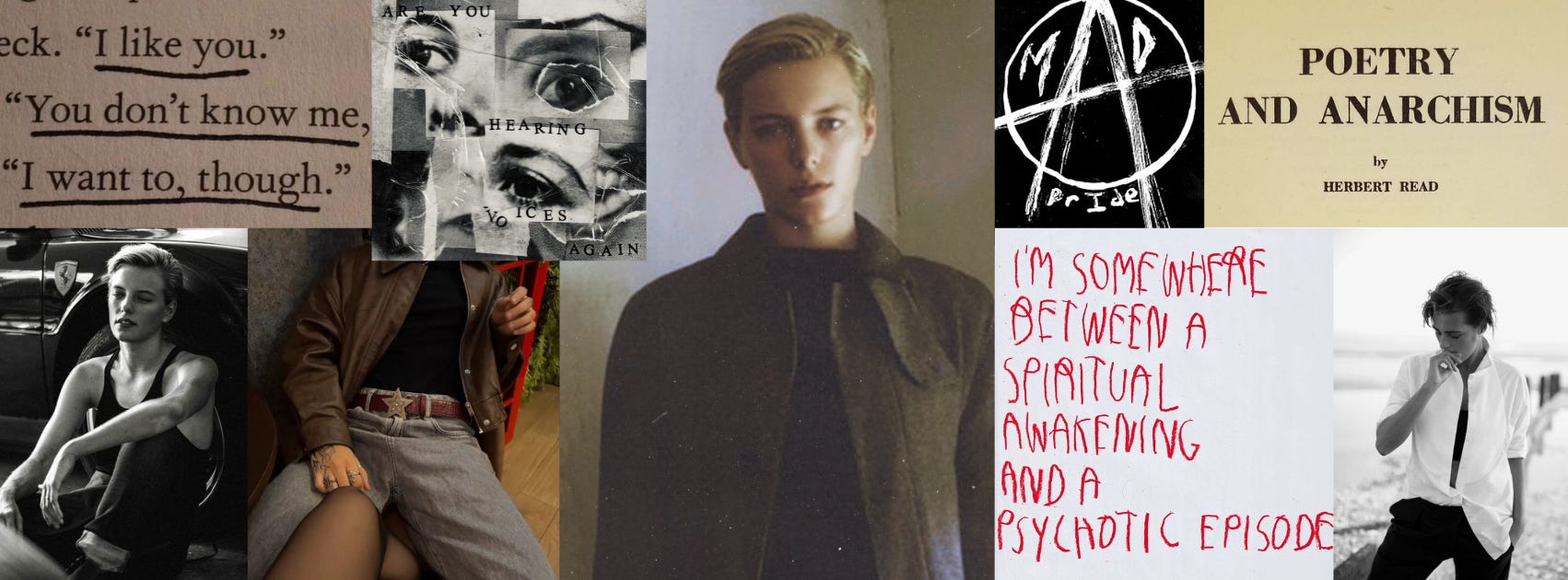
Works of Vale’s and Cory’s writing, all actually my real mental health writing, serve as a plot device to explore complicated experiences of madness and gradually reveal the backstories of these characters. The autofiction continues throughout the story—all of Cory’s past experiences are my real ones.
But it’s writing the conversations between these characters that has truly blown me away as a corrective experience.
Let’s be real for a second—I’m writing Vale as a kind of ideal love-interest. (This is my self-indulgent romance; bite me.) At the outset I was worried about turning them into a sort of two-dimensional ChatGPT-like mirror who would robotically say everything I wanted to hear when I was depressed. But as I’ve developed Vale into a fully-fledged complex character, they have rapidly developed their own voice.
Vale does often tell Cory what she needs to hear, what I needed to hear. But because I’m writing them, I have to follow their rationale and thought processes as they articulate these things. I have to fully step into their head, which means seeing Cory, who is me, as this person I really care about, someone who is struggling through a difficult period of life and questioning her own worth.
“Becoming” Vale has offered me a kind of outside perspective on myself I’ve never before been able to access. There are ways I’ve tried to offer myself compassion that fall flat because I don’t really believe them, things my therapist tries to tell me that I want to integrate, but I can’t.
But somehow, when Vale, my alternate-universe love interest tells me their version of the same things? For some reason, I start to buy it.
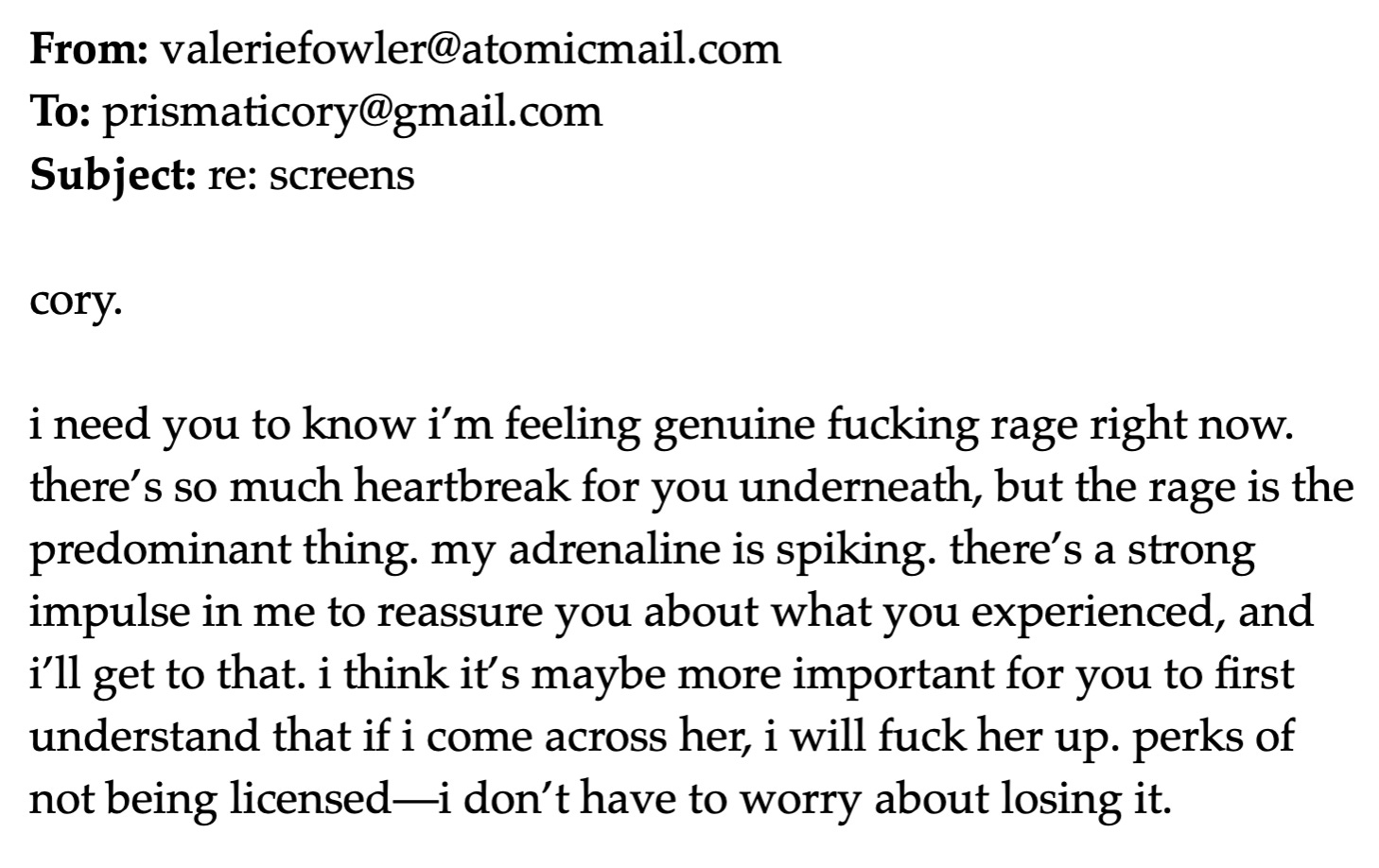
This started to hit me last week when I wrote an email exchange between my two characters about a past abusive relationship that Cory—I—had experienced. All of the details Cory shares with Vale are real.
The process of writing, of course, means I had to ask: how would Vale respond to this information? They’re extremely fond of Cory, they have a lot of empathy for her because of their very particular shared experiences of madness and mental illness. They feel deeply protective of her. They’re also an anarchist punk who fully owns their shadow self, including their anger and capacity for violence. So they get fucking mad.
It was immediately healing for me to imagine someone getting angry on my behalf about the things I experienced in that relationship. It goes beyond just empathy or compassion into something we all desperately need: the idea that someone cares enough to want actual justice for us.
But this is the part that really shocked me as I was writing the exchange:
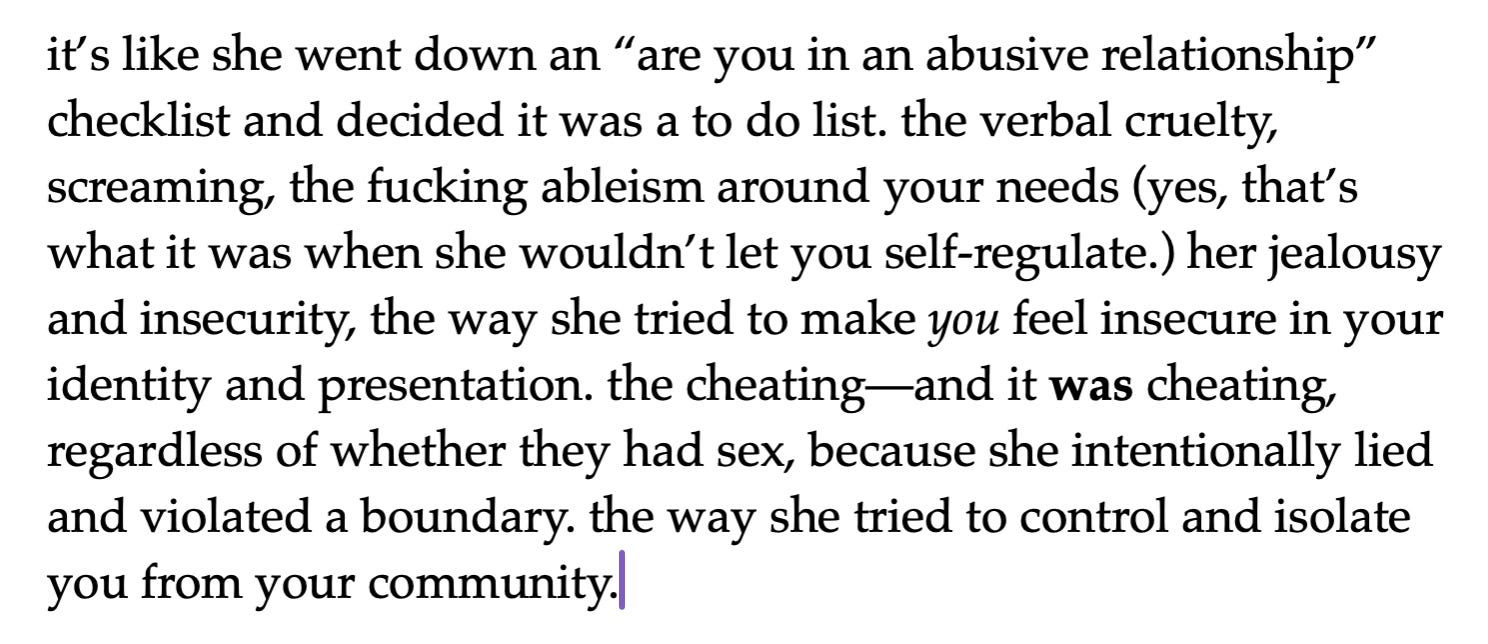
That first line is not something I feel like I “came up with”—it felt like something I channeled. I have not been able to stop thinking about this particular line. As I was considering how Vale might respond to the specifics of Cory’s abuse, I was thinking about how long Cory’s email was. It covers so many examples of behavior that is categorically not okay.
With it all laid out, it hit me and Vale at the same time that what Cory described covered nearly all the bases of an abusive relationship.
I have written about this relationship before for myself in the sense that I’ve made lists of things that happened to un-gaslight myself. But I have never considered things from Vale’s perspective until right now.
Vale and Cory’s conversation continues into territory I have barely even dared to tread even in my own mind.

Vale goes on to explain why what Cory has experienced is assault, even though she has been unable to frame it that way. In the same way you might offer care and reassurance to a friend who has experienced sexual violence, I stepped into Vale’s head to offer that validation to Cory. To myself.
And now, I believe Vale about what I experienced—or at least, I’m much closer to believing them than I once was.
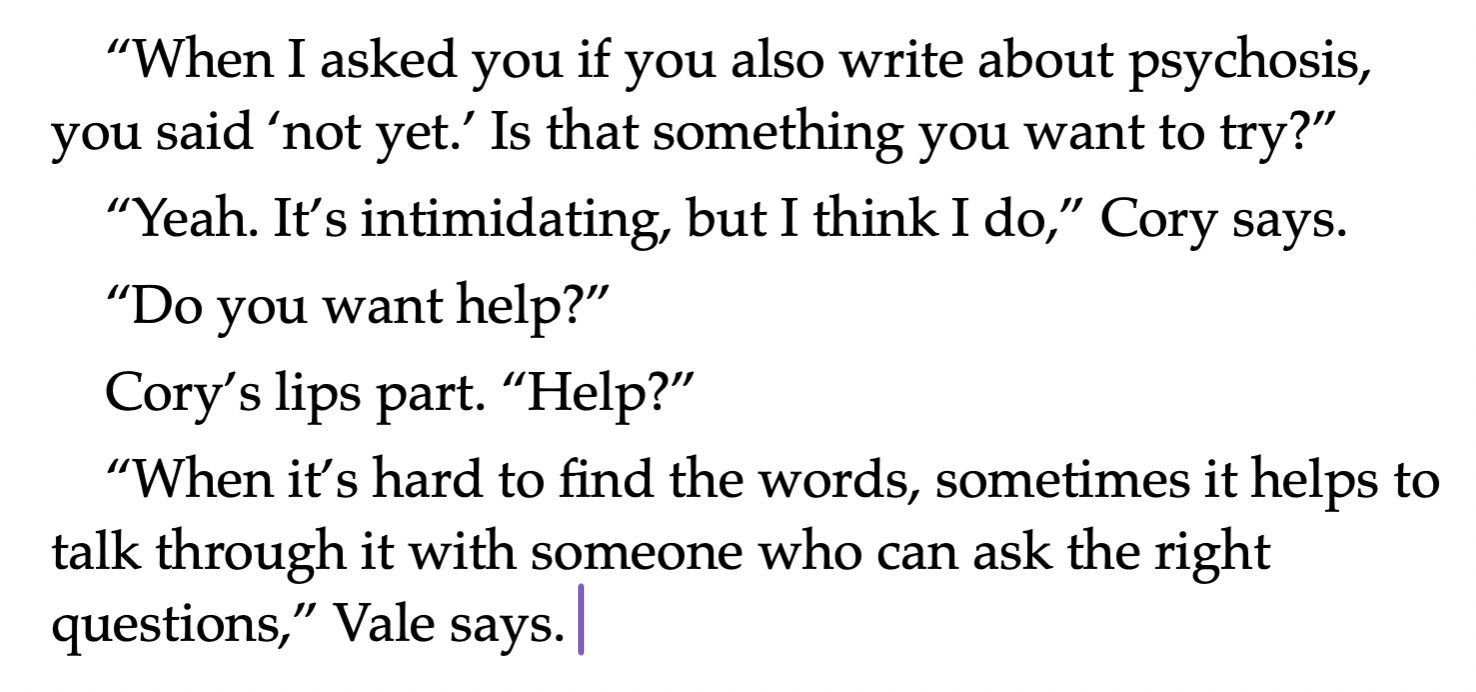
I’ve been trying to write about my experiences of mania and psychosis for over a year, and I’ve written a lot, most of which I haven’t shared anywhere. But I kept getting stuck, because I kept trying to write about it all in the form of one, linear narrative, when it doesn’t feel linear in my memories. It’s confusing. Jumbled.
It has been much easier to write about these events by having them come up naturally in the course of Vale and Cory’s conversations. It doesn’t have to be linear. They’re talking about different aspects of these experiences, revealing their layers, not trying to put them all in order. I had been trying to write about my experiences in a way that would make sense to non-mad outsiders, trying to create something coherent, clean-cut. In this work of fiction, I am instead writing about two characters who are simply finding ways to articulate similar experiences to each other, building understanding and camaraderie through that.
In some ways, I feel like I’m cursing my writing process by sharing this project while it’s maybe 40% written (though 43,000 words isn’t nothing!) But the truth is, I’m not writing with an intention to publish, though it’s something I’ll explore down the line. I am writing this work wholly for myself. If it never sees the light of day outside of a document in my computer, that’s okay, because writing this is radically reshaping my self-concept and understanding of my past.
It’s also really, really fun. It’s a slow-burn romance with all of the expected story beats. What can I say?
Chances are good that I will eventually finish this work, and I’ll definitely be sharing my process on Instagram and writing about writing here as I do.